There were a few things I wanted to write about recently ranging from all the discussion around OSGi in the Java community (and eBay) to what I would expect from an industrial grade Identity Provider (hint: it is not about which protocol it uses) and from when not to use No SQL to the emergence of a little known art and science called Entity Resolution, but let me resume my posts after a month with this: Microsoft announced that it would not ship CardSpace 2.0.
Having worked on a authentication concept with MSFT for eBay sellers, I had mixed feelings about this. On one hand I was on the record not supporting the use of CardSpace for eBay sellers (or buyer). On the other hand I am concerned that technical community discounts the significance of Claim Based identity altogether and concludes that "FaceBook Conncet" is all we'll ever need.
There is a good reflection (from an insider's point of view) on Card Space here. (courtesy Gunnar Peterson) My personal view (and the reason I didn't support the adoption of Card Space at eBay) though centers around the challenges of "Change of Behavior" required by Card Space.
Basically, CardSpace failed b/c it requied uses to change their behavior. See, the "User name and password" protocol (a simple challenge and response) IS a protocol, one where a human being (a normal user) is a participant in. It has taken about 20-30 years (depending on how you count) to train users what to do when they see a "login panel" , the "login panel" contract is so widely understood that despite all of its short coming is the most viable remote authentication protocol we have today. It is flawed, it is costly, it is not secure, but it is a widely understood by users on the other end of the protocol. CardSpace, despite all its advantages, was not understood, would (and did) make people confused, they did not know what to do when the CardSpace screen popped up ... a technology whose adoption depends on change of a strongly learned behavior is unlikely to succeed (or at least I didn't think eBay sellers - not the early adopters of technology - would learn and accept it).
It also didn't help that a lot of browsers didn't support it (installing a plug-in does not count), and the fact that developers didn't know how to issue cards (or validate, update or revoke them).
Having said that, I did like the idea of decentralized identity provider and not having any one identity provider to be THE identity provider that everyone else had to rely on (putting user in control of their own identity). Compare this with a world where one identity provider (be it facebook or Google or twitter or anyone else) is the dominant identity provider because it is easy for RPs to embed a simple button and for users to click on it.
Monday, February 21, 2011

Sunday, January 2, 2011
Kingdom of Nouns ...
The other day I took advantage of a rare couple of hours of peace and decided to catch up on my blog readings, I came across a nice post by Joel Spolsky from the Joel on Software fame on Map/Reduce. The post is probably one of the clearest writing on origin of Map/Reduce and what it does - if you haven't read it I highly recommend it, even if you are a Map/Reduce pro - in the course of explaining Map/Reduce he talks about how thinking in terms of functional languages made inventing Map/Reduce possible and implying that if one only think in term of OO languages where functions (or verbs) are not first class citizens coming up with an abstraction such as map() or reduce() function is tough. He includes a link to another interesting post title "Execution in Kingdom of Nouns" that contends that Java is a kingdom of nouns and verbs are "owned" by nouns. I like this post too, especially the witty narration. However I disagree with conclusion (or implication) that one can not effectively or elegantly model certain class of thoughts and abstraction with a statically typed language like Java.
Look at any natural language, they ALL seems to be kingdom of nouns. Look at how babies start to talk, they almost excursively uses nouns for a while and THEN add verbs to form sentences (or form thoughts). The core example of the post for taking garbage out that I copied here:
get the garbage bag from under the sink
  carry it out to the garage
  dump it in the garbage can
  walk back inside
  wash your hands
  plop back down on the couch
  resume playing your video game (or whatever you were doing)
(italic emphasis is from original post)
This example is there to show that a normal function is a sequence of verbs and
can be easily expressed without needing a "noun", but the noun here is hidden,
it is the "subject" that is actually doing it. In a function language like JavaScript
the replacement would be the "global" scope, or some form of function that author would
create called "takeOutTheGarbage()" and call it from different "context"s, those context
would be the nouns.
I admit,I am not a language guy, I am more of a modeling guy but i do think that
type spaces formed around collaborating nouns (subject, objects etc.) are capable of modeling and asbtracting
any concept/thoughts. I do agree that some folks in the "Javaland" overuse classes and have too many
factories and adapters, mediators, visitors etc. but this is more of a "fashion" issue than a basic
OO modeling issue.
I also agree (and have seen) that functional languages are better for certain tasks
but I wishing for live in a "kingdom of verbs" is a bit extreme in my view, after all
verbs are all performed by somebody/soemthing unless you prefer to live in the land of anonymous.
Sunday, December 26, 2010
Best description of what architecture is ... by Charles Darwin (yes, THE Charles Darwin)
Here is a quote attributed to Darwin:
"It is not the strongest of the species that survives, nor the most intelligent that survives. It is the one that is the most adaptable to change."
Right there, for me, is the best definition of software architecture I have seen. Software architecture is whatever you do that allows your system to be adaptable to whatever changes its environments throws at it (scale, hardware failure, legal changes, change of business model, new forms of distribution etc.), better yet Darwin goes to to say
"In the long history of humankind (and animal kind, too) those who learned to collaborate and improvise most effectively have prevailed."
So in his view the keys to adaptability are collaboration and improvisation, which I'd translate it into modern systems as "Communication" and "Experimentation". Communication is THE key to collaboration and a quality lacking in a large number of leading engineer/architects. The core communication skill here is not about communicating what one's particular solution to a problem is, but more a style that is about inquiry, a style that illicit input and views from all significant parties and synthesize them into models and hypothesis and communicate them back and form common understanding (does your architect do that?)
Experimentation is both a personal quality and something that must built into any system as a first class architecture requirement. Experimentation is generally under-valued in architecture discussion. Systems in general have multiple views, the most popular being the 4+1-views, I would add an "Experimentation View", a view of architecture that describes which sub-systems can be experimented with and in what ways, and how would an experiment success be measured. More on "Experiment View" later, but for, I am even more convinced that analogies with and inspiration from biological systems is worthy guide for designing software systems.
"It is not the strongest of the species that survives, nor the most intelligent that survives. It is the one that is the most adaptable to change."
Right there, for me, is the best definition of software architecture I have seen. Software architecture is whatever you do that allows your system to be adaptable to whatever changes its environments throws at it (scale, hardware failure, legal changes, change of business model, new forms of distribution etc.), better yet Darwin goes to to say
"In the long history of humankind (and animal kind, too) those who learned to collaborate and improvise most effectively have prevailed."
So in his view the keys to adaptability are collaboration and improvisation, which I'd translate it into modern systems as "Communication" and "Experimentation". Communication is THE key to collaboration and a quality lacking in a large number of leading engineer/architects. The core communication skill here is not about communicating what one's particular solution to a problem is, but more a style that is about inquiry, a style that illicit input and views from all significant parties and synthesize them into models and hypothesis and communicate them back and form common understanding (does your architect do that?)
Experimentation is both a personal quality and something that must built into any system as a first class architecture requirement. Experimentation is generally under-valued in architecture discussion. Systems in general have multiple views, the most popular being the 4+1-views, I would add an "Experimentation View", a view of architecture that describes which sub-systems can be experimented with and in what ways, and how would an experiment success be measured. More on "Experiment View" later, but for, I am even more convinced that analogies with and inspiration from biological systems is worthy guide for designing software systems.
Wednesday, December 22, 2010
Cannonical Use Cases for a Relying Party
I have always felt that in identity community we spend most of our time discussing identity providers and their concerns (such as token format, protocol etc.) and do not spend enough time on and attention to relying parties. At eBay we play both roles i.e. we are both an identity provider (we provide sellers' identity and attributes to 3rd party developers) and relying party (accepting identities provisioned outside eBay marketplaces as eBay users). I can say that building a architecturally sound relying party is as challenging as building an identity provider.
In this post I simply want to enumerate the major use cases that any major relying party (that is anyone that for example plans to accept Facebook Connect) has to account for. I used the qualifier "major" to denote that these use cases are important if a given relying party has millions of uses and many services and applications (much like eBay does).
The list of use case are:
1-Sign-In and out
2-Connect and Reception
3-Link/Unlink
4-Profile Access Extension
5-Role Elevation
6-Recovery
7-Disconnect
8-Force Authentication
9-Customer Support
10-Capturing Alternative/Second Secret
and here is the descriptions:
1-Sign-In and out: This includes changes to your standard sign-in page to make it a "federated sign-in" page. The challenge here is mostly user experience i.e. how to design the UI correctly to achieve two goals:
- Not confuse existing users who will not sign up with external IDP
- Communicate to the user of external IDP what they need to do (without creating the NASCAR problem)
There are also techniques for detecting the IDPs that user may have an account with and to show a "smart" list of IDPs
2-Connect and Reception: Once users clicks on "Connect" button (if you are using connect style IDPs such as FB) or entered her OpenId URI (although this is unlikely to be adopted by users), the user is send to IDPs to sign-in and given consent to his/her information to be send to you site - let's refer to this process as Connect - then user is sent back to your site to a page/application that we refer to as "Reception". This is the processes that greets the users for the first time and provision an account in RP for him/her. I use the word "reception" to make it distinct from "registration" which is when provision is done based on data collected by RP itself. The reception process is significant b/c it covers the gap between data received from IDP and what is needed for a user to be provisioned, also it assigns the roles for new user. These roles are typically minimal since data coming from external IDPs are normally not trusted or verified. Also during reception token received from external IDP together with associated meta data is stored in a central location accessible to different functional units (application) of RP
3-Link/Unlink: Another use case (often part of reception) is to detect whether the user connecting to RP is one who already has an account. The detection can be done based on mapping the data received from IDPs to existing account, the simplest form is to check whether email addressed returned by IDP already exists.Once an account is detected, user has to prove s/he actually owns it (normally by providing password) and the accounts are link. Since architecture hygiene calls for symmetric operation, you should also allow for unlinking of accounts.
4-Profile Access Extension: RP obtain a token during reception (such as OAuth token that comes with FB Connect), this token stores a set of access permissions to user resources (perhaps hosted by IDP). Any large RP has a set of applications that will use this token (for example MyeBay application as well as eBay Search Application) it is likely that one of these applications requires more information/access privileges that user originally consented to, in these case RPs should provide a central capabilities that conduct the process of requesting, receiving extended permissions from user and updating token meta information associated with user
5-Role Elevation: The first time users connect to RP they are granted a certain role (roles), normally this is a basic role since data provided by most IDPs are not reliable (eBay as an IDP does provides verified reliable data), at some point during the user's life cycle, users needs to perform an action that requires higher role assignment, in this cases RPs should provide capabilities to assign users higher role, this normally requires users to enter more information or go thru verification. This processes produce more attributes that will become part of users profile at RP.
6-Recovery: Every RP always has to establish a method for externally provisioned identities to authenticate WITHOUT the presence of external IDP. What does this mean? suppose you accept FB Connect and FB is down for 6 hours (an event that recently happened), further imagine that you operate a site that every minute of users not being able to login means financial loss. What do you do in this scenario? You may say, this is easy, ask users to enter a password during the first time reception, but wouldn't this defeat the whole purpose (or a big part of it) of users not having to remember many passwords?
7-Disconnect: All RPs must provide the capability for a user to "disconnect" i.e. close the account that was created based on an identity provided by external IDP. I personally believe that user owns his/her data and if user wants to disconnect and remove all of his/her activities from the record. s/he should be able to (to the extent that is legal)
8-Force Authentication: This is actually a capability of IDP, but RPs need to use this when they require user to be authenticated regardless of session's authentication state as seen by IDP. For certain operation RPs require a fresh session (or session that started in the past N minutes), in this cases RPs should request a forced authentication (I am using SAML terminology here) from IDP.
In this post I simply want to enumerate the major use cases that any major relying party (that is anyone that for example plans to accept Facebook Connect) has to account for. I used the qualifier "major" to denote that these use cases are important if a given relying party has millions of uses and many services and applications (much like eBay does).
The list of use case are:
1-Sign-In and out
2-Connect and Reception
3-Link/Unlink
4-Profile Access Extension
5-Role Elevation
6-Recovery
7-Disconnect
8-Force Authentication
9-Customer Support
10-Capturing Alternative/Second Secret
and here is the descriptions:
1-Sign-In and out: This includes changes to your standard sign-in page to make it a "federated sign-in" page. The challenge here is mostly user experience i.e. how to design the UI correctly to achieve two goals:
- Not confuse existing users who will not sign up with external IDP
- Communicate to the user of external IDP what they need to do (without creating the NASCAR problem)
There are also techniques for detecting the IDPs that user may have an account with and to show a "smart" list of IDPs
2-Connect and Reception: Once users clicks on "Connect" button (if you are using connect style IDPs such as FB) or entered her OpenId URI (although this is unlikely to be adopted by users), the user is send to IDPs to sign-in and given consent to his/her information to be send to you site - let's refer to this process as Connect - then user is sent back to your site to a page/application that we refer to as "Reception". This is the processes that greets the users for the first time and provision an account in RP for him/her. I use the word "reception" to make it distinct from "registration" which is when provision is done based on data collected by RP itself. The reception process is significant b/c it covers the gap between data received from IDP and what is needed for a user to be provisioned, also it assigns the roles for new user. These roles are typically minimal since data coming from external IDPs are normally not trusted or verified. Also during reception token received from external IDP together with associated meta data is stored in a central location accessible to different functional units (application) of RP
3-Link/Unlink: Another use case (often part of reception) is to detect whether the user connecting to RP is one who already has an account. The detection can be done based on mapping the data received from IDPs to existing account, the simplest form is to check whether email addressed returned by IDP already exists.Once an account is detected, user has to prove s/he actually owns it (normally by providing password) and the accounts are link. Since architecture hygiene calls for symmetric operation, you should also allow for unlinking of accounts.
4-Profile Access Extension: RP obtain a token during reception (such as OAuth token that comes with FB Connect), this token stores a set of access permissions to user resources (perhaps hosted by IDP). Any large RP has a set of applications that will use this token (for example MyeBay application as well as eBay Search Application) it is likely that one of these applications requires more information/access privileges that user originally consented to, in these case RPs should provide a central capabilities that conduct the process of requesting, receiving extended permissions from user and updating token meta information associated with user
5-Role Elevation: The first time users connect to RP they are granted a certain role (roles), normally this is a basic role since data provided by most IDPs are not reliable (eBay as an IDP does provides verified reliable data), at some point during the user's life cycle, users needs to perform an action that requires higher role assignment, in this cases RPs should provide capabilities to assign users higher role, this normally requires users to enter more information or go thru verification. This processes produce more attributes that will become part of users profile at RP.
6-Recovery: Every RP always has to establish a method for externally provisioned identities to authenticate WITHOUT the presence of external IDP. What does this mean? suppose you accept FB Connect and FB is down for 6 hours (an event that recently happened), further imagine that you operate a site that every minute of users not being able to login means financial loss. What do you do in this scenario? You may say, this is easy, ask users to enter a password during the first time reception, but wouldn't this defeat the whole purpose (or a big part of it) of users not having to remember many passwords?
7-Disconnect: All RPs must provide the capability for a user to "disconnect" i.e. close the account that was created based on an identity provided by external IDP. I personally believe that user owns his/her data and if user wants to disconnect and remove all of his/her activities from the record. s/he should be able to (to the extent that is legal)
8-Force Authentication: This is actually a capability of IDP, but RPs need to use this when they require user to be authenticated regardless of session's authentication state as seen by IDP. For certain operation RPs require a fresh session (or session that started in the past N minutes), in this cases RPs should request a forced authentication (I am using SAML terminology here) from IDP.
Monday, December 6, 2010
OAuth protocol and "Emdedded Browser" : Illustration of a simple security decision making framework
The discussion about whether to use an embedded browser or a full browser while performing OAuth protocol ,although passionate, is nothing new. Instead of expressing a position (I am for a full browser for the record), I want to use this case to illustrate a simple framework I use to make security design/implementation decision.

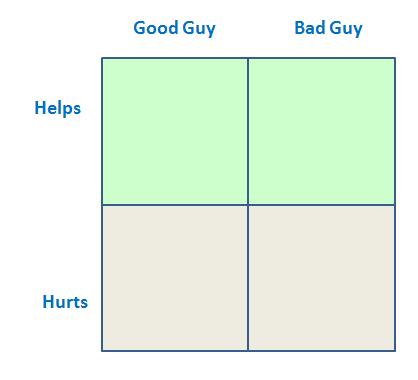
For every question/decision we designate one engineer as "good guy" and one engineer as "bad guy" and we ask each how this decision help or hurt you. I emphasis that it is critical to think and view a decision from a bad guy point of view. Most of us are basically not fraudsters and think in terms of "getting things done" and "being helpful", we rarely look at a feature and think to ourselves "How can I abuse it" (if you do, please contact me, I may have a job for you), so we assign an engineer just to do that.
Of course we want all our decision to be just as shown in the figure above :Help good guys and hurt bad guys. But that is not always the case, take using the embedded browser (and not a full pop up) to perform OAuth. This decision looks more like this:
 It helps good guys (by not having every app render a login panel, perform authentication and deal with errors etc.), but it also helps bad guys (as illustrated nicely by my friend and colleague Yitao Yao here - facebook is only one example) by making phishing easier. (it is worth pointing out that having application capture user secrets directly is along the counter diagonal in matrix above: hurts good guys and helps bad guys)
Does this mean you should never do this? I wish there was a simple and universal answer, but there is not.
In general you should not use embedded browser unless there is a good reason and more importantly the decision maker is fully aware of the risk (at least seen the matrix above and know the bad guys will benefit). Mitigating circumstances could be unattractive economy of fraud (your application is not a prime target fraudsters), you believe fraudsters can not effectively distribute their application to a large enough group of people, your user base is exceptionally savvy (I envy you) or your mobile operator has a good control over nature of applications and what they do (think Apple-like).

For every question/decision we designate one engineer as "good guy" and one engineer as "bad guy" and we ask each how this decision help or hurt you. I emphasis that it is critical to think and view a decision from a bad guy point of view. Most of us are basically not fraudsters and think in terms of "getting things done" and "being helpful", we rarely look at a feature and think to ourselves "How can I abuse it" (if you do, please contact me, I may have a job for you), so we assign an engineer just to do that.
Of course we want all our decision to be just as shown in the figure above :Help good guys and hurt bad guys. But that is not always the case, take using the embedded browser (and not a full pop up) to perform OAuth. This decision looks more like this:
Does this mean you should never do this? I wish there was a simple and universal answer, but there is not.
In general you should not use embedded browser unless there is a good reason and more importantly the decision maker is fully aware of the risk (at least seen the matrix above and know the bad guys will benefit). Mitigating circumstances could be unattractive economy of fraud (your application is not a prime target fraudsters), you believe fraudsters can not effectively distribute their application to a large enough group of people, your user base is exceptionally savvy (I envy you) or your mobile operator has a good control over nature of applications and what they do (think Apple-like).
Sunday, December 5, 2010
Kitchen Meeting
I started an experimentation a few weeks back. Instead of scheduling and holding a meeting in one of eBay's formal meeting rooms, I tried to meet with people in kitchen or cafe (or starbucks across the street from the Hamilton campus) - now this is partly b/c it is getting too tough to find a free room, but I also had a hypothesis that when people meet in informal setting - specially a place that has to do with eating - they are more likely to collaborate.
I have to say the results are mixed so far, on one hand it indeed does make a difference, people seem to be friendlier and more willing to see "the other side" of issue - whatever it might be. However I also noticed that they are more likely to "forget" or back-off from agreements or conclusions that were reached too.
For now I keep doing this as much as I can, at least it gives me an incentive to keep the number of people in a meeting to 3 people max, this alone helps increase the effectiveness of meetings.
I have to say the results are mixed so far, on one hand it indeed does make a difference, people seem to be friendlier and more willing to see "the other side" of issue - whatever it might be. However I also noticed that they are more likely to "forget" or back-off from agreements or conclusions that were reached too.
For now I keep doing this as much as I can, at least it gives me an incentive to keep the number of people in a meeting to 3 people max, this alone helps increase the effectiveness of meetings.
Wednesday, October 27, 2010
PayPal Identity Services Talk @ PayPal Innovate 2010
Today at the PayPal Developers conference Ashish Jain, my friend and colleague and PayPal’s point man on all things identity, talked about PayPal vision of identity and PayPal Identity Service in his presentation titled, not surprisingly, “PayPal Identity Services”.
If you are involved in the world of internet, as a developer or even an observer, or if you have attended any web related conference in the past 12-18 month (including our own DevCon) you must be familiar with the core identity problem: users have too many accounts, too many password, too often they forget them, it is too easy to phish passwords and too expensive for companies to support users who either forgot their passwords or have had their account taken over …. Ashish talked about it in his presentation (as it is mandatory for these presentations, including mine, to recount the carnage first).
You may have guessed the next step, PayPal, among many others, offers to be an Identity Provider (IDP). Your one and only account you ever need (at least for whenever you want to shop on the Internet).
You may think, so what? There are so many other identity providers (most notably Facebook) … but (as Lee Corso of ESPN says) “not so fast my friend”, there is actually a difference in this game of being identity provider between PayPal and everyone else, what Ashish, modestly, calls “Qualified Data” (interestingly the second bullet point in his slide – why not the first? I have to ask him).
See, as it turns out providing identity (as in what an IDP does) it is not that hard, pick a protocol (OpenID, OAuth, SAML …) and transfer identity data (unique identifier, name, email, phone number etc.) from the IDP to Relying Party (RP). You can do that in few hours (literally), what turns out to be hard (and expensive and complex), is providing “High Quality” identity, as in identity data the someone actually validates and make sure they are accurate and up to date and actually owned by the person who claims s/he owns it. This is what Ashish means by “Qualified Data”. Now if you are a merchant, which identity you rather rely on? An identity from a site that simply takes users claims (about what her name is, where she lives etc.) and toss it over to you or from PayPal where this set of data is verified and maintained and by the way you know that there is a valid financial/payment instrument attached to it?
Too often people responsible for building an identity provider argue endlessly about merits of protocols, compare OpenID to OAuth and talk about how complex SAML is. In the process they miss the much bigger point: what matters is the quality of identity provided not the means by which it is provided.
This is what make PayPal identity (regardless of whether they use OpenID or OAuth or anything else) potentially the most interesting and useful identity in my view.
Ashish also shows a demo where PayPal OpenID service is wrap by Gigya API. Gigya is an aggregator of identity provider, instead of learning multiple APIs from different IDPs, developers simply deal with Gigya API. It is an interesting concept. Check them out here.
It would be interesting to see how far PayPal push their Identity Service (both in terms of end user adoption and merchant adoption) and whether or not they offer different classes of identity (based on data quality) and respective financial assurance levels.
